

Our Story/Alexandra Close
February 2015
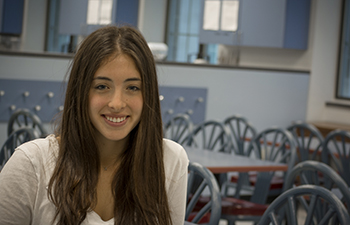
On campus, in the community and through research, Alexandra Close is changing the way people think about food.
The nutritional sciences major says she is passionate about working with and researching children to find ways for them to develop healthy eating behaviors. After she graduates in Spring 2016 she plans to become a registered dietician.
“I like the idea that you can change someone’s life by simply adjusting their diet,” she said.
The psychology minor from Boston, Massachusetts, originally came to Penn State interested in biology, but after taking an introductory nutrition course, she “fell in love,” she said.
“I’ve always really liked food, and have been conscious of the way it can affect our bodies,” she said. “I’m a foodie.”
More than 4,500 Penn State students are enrolled in the College of Health and Human Development (HHD) studying a wide-array of fields, each committed to the concept of improving the quality of life for others. Close, who found a home in the Department of Nutritional Sciences (NUTR), is one of those HHD students, and this is her story.
In the lab
Since 2014, Close has been working in Kathleen Keller’s Metabolic Kitchen and Children’s Eating Behavioral Lab. Keller is a Mark T. Greenberg Early Career Professor for the Study of Children's Health and Development and assistant professor in the Department of Nutritional Sciences and the Department of Food Science.
In the lab, Close’s responsibilities include collecting and entering data, leading visits with participants, and aiding in the development of experimental paradigms.
Currently, Close is writing a grant to fund research in child eating behaviors to study if maternal maladaptive eating behaviors relate to the development of overeating and obesity development in children.
“The eating behaviors that are formed in early childhood have the potential to last a lifetime, so it’s important children create healthy ones from the start. It’s up to us to figure out how we can aid them in developing these healthy behaviors. ,” Close said.
The lab, Close said, is an “incredibly supportive environment.”
Since working in the lab, Close said her responsibilities have increased and she has had the opportunity to be trained by Ph.D. candidates. These factors, she said, have really enhanced her overall experience while studying nutrition and enabled her to grow and develop critical thinking skills.
“I really feel comfortable in that setting and environment,” she said.
On campus
Outside the lab, Close is involved with LifeLink PSU, a campus organization that provides State College Area School District special-needs students an opportunity to interact with students their own age in an environment that is socially and academically conducive to continued growth.
Close develops and teaches weekly lessons about healthy diet and lifestyle to these students with the help of members from the Student Nutrition Association (SNA).
“It’s been an amazing opportunity,” she said.
About 11 special needs high school students, between the ages of 18 and 21, attend the lessons, Close said. The sessions are focused on government-recommended nutrition requirements, such as ChooseMyPlate.gov. The lessons also refer to EatRight.org, a program of the Academy of Nutrition and Dietetics.
This semester, Close has been working with the students to teach them how to change their eating behaviors.
“They are all grasping the knowledge and I’m hoping they will be able to apply it in real life situations,” she said. “As a group, we’ve all learned a lot from these lessons.”
Close said working with LifeLink PSU has been rewarding because she notices the students retaining the information.
“They get involved,” Close said. “I make sure the lessons have activities and group discussions and are not just lecture-based.”
In the community
Off campus, Close is taking her love and knowledge of food and nutrition into the community in new ways.
As community service chair of the Penn State Student Nutrition Association, Close works with local food banks.
Close noticed Bellefonte’s FaithCentre food bank wasn’t getting as much attention as needed. She wrote a grant in the hopes to receive funding for a program to create recipe cards that would feature ingredients given out at the Bellefonte food bank.
The idea behind the program is for the members of the Student Nutrition Association to create healthy, simple and cheap recipes that would be put into the food baskets given out at the food bank. Close and the members of SNA would then go to the food bank and give out samples of the recipes so clients of the food bank could taste the dish before they make it at home.
Between LifeLink PSU and area food banks, Close said she enjoys assessing food and nutrition needs within the community. However, she cannot do it alone.
“I like to get as many people involved as possible,” she said. “I can start a program in the hopes of impacting the community, but I can’t do it alone.”
In addition to NUTR, there are a variety of areas for students to study within HHD through the Departments of Biobehavioral Health, Communication Sciences and Disorders, Health Policy and Administration, Human Development and Family Studies, Kinesiology, Nutritional Sciences, Recreation, Park, and Tourism Management, and the School of Hospitality Management. Learn more about HHD.